

HR has more data than ever before. But for many organizations, that has not translated into better decisions.
Across conversations with HR leaders, the same themes keep surfacing: fragmented people data, low trust in the numbers, difficulty connecting systems, too much descriptive reporting, and not enough insight that leads to action. There is also growing pressure to show measurable value in a function that is often treated as a cost center rather than a driver of business outcomes.
That is the real risk.
The issue is not that HR lacks data. The issue is that too many HR teams are still limited to reporting while the business increasingly needs prediction, prioritization, and guidance. HR leaders are being asked to weigh in on retention, workforce planning, skills gaps, manager effectiveness, employee experience, and how AI may reshape roles and work. Those are not reporting questions. They are decision questions.
And when HR analytics stops at dashboards, HR loses the chance to shape those decisions with confidence.
The gap between reporting and real decision support
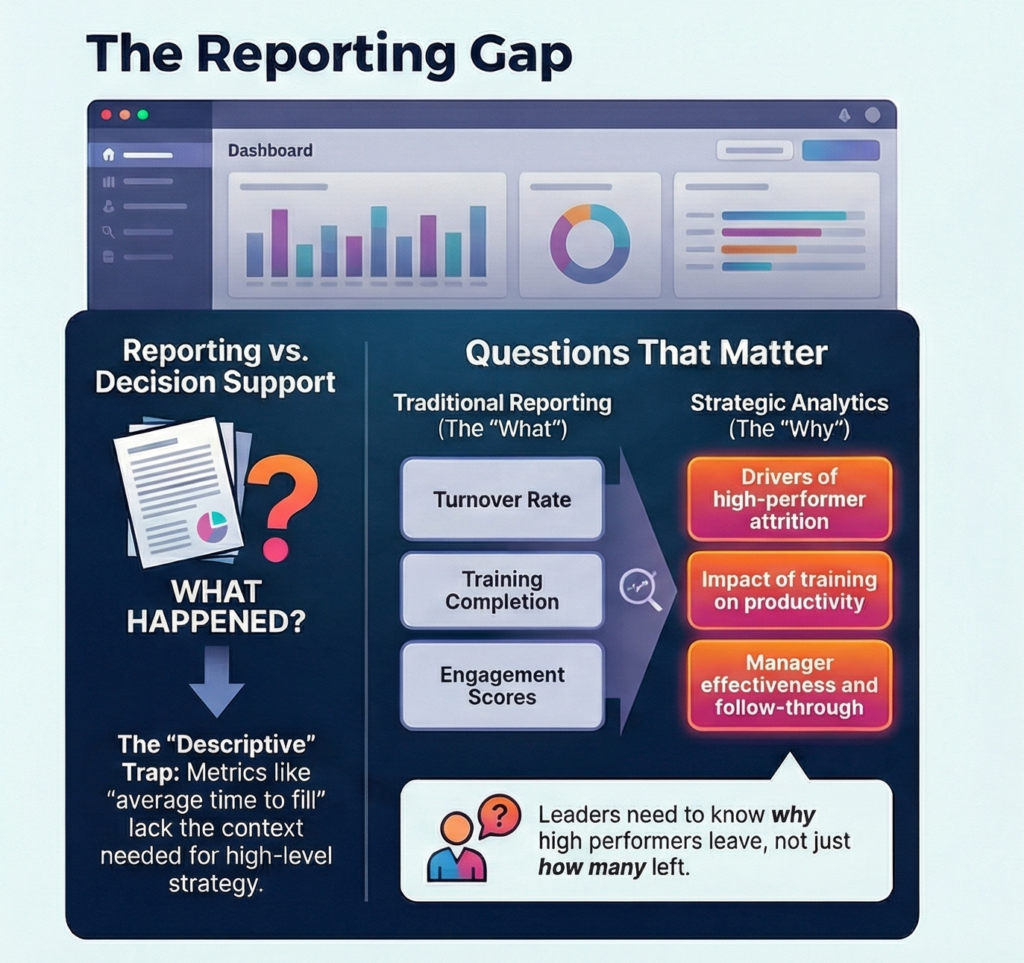
A lot of HR analytics today still lives in the descriptive world.
- How many people left last quarter?
- What were engagement scores by department?
- How many employees completed training?
- What is our average time to fill?
Those questions matter. But by themselves, they are not enough.
Leaders usually want to know something deeper.
- Why are high performers leaving in one part of the business and not another?
- Which managers are acting on employee feedback and which are not?
- Is training actually changing behavior or performance?
- Which open roles create the biggest operational risk if they stay unfilled?
- Where will AI and automation create the biggest change in roles, workload, and reskilling needs?
This is the gap many HR teams are feeling. Reporting tells you what happened while better analytics help you understand why, anticipate what is next, and act with more confidence.
That is where the art of possible becomes very practical.
- Predictive analytics can help identify which employees or teams show early signs of attrition risk.
- Prescriptive analytics can help prioritize the actions most likely to improve retention, performance, or manager follow-through.
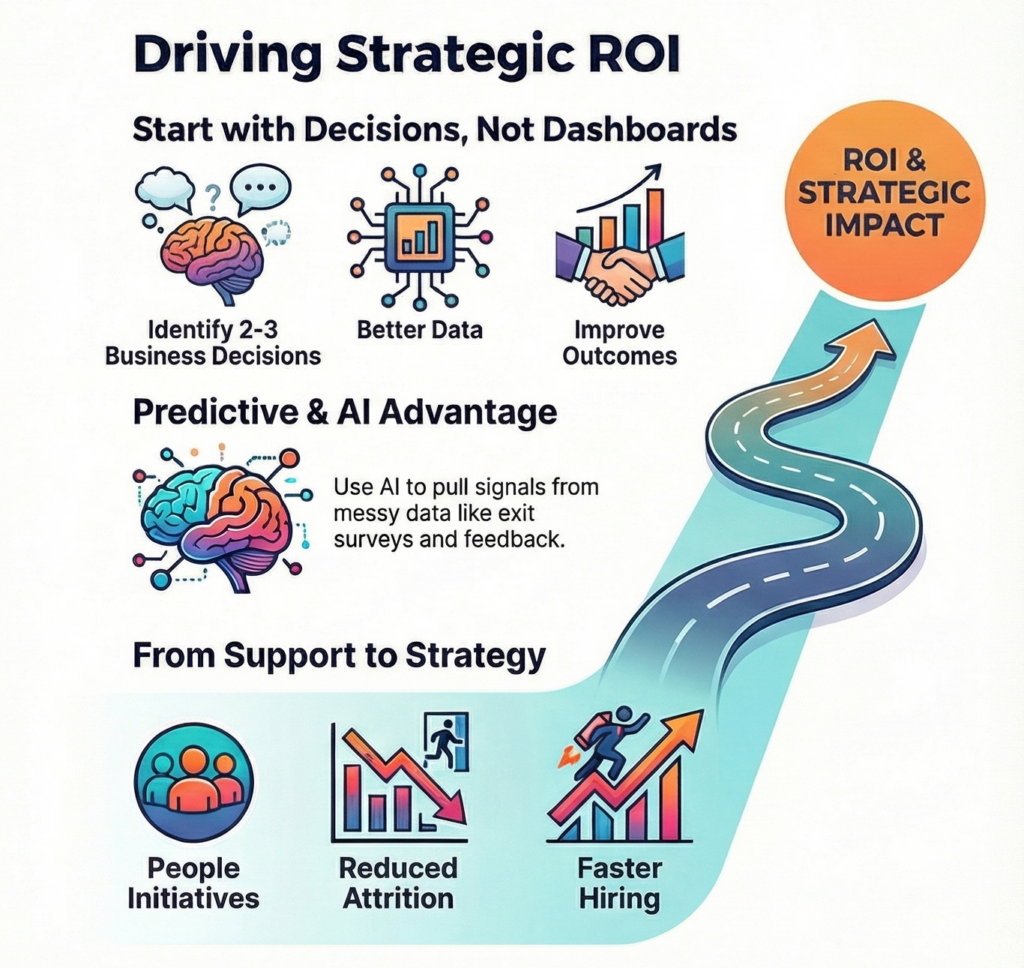
- AI can help pull signal from messy, unstructured data like engagement comments, exit surveys, or employee feedback at a scale that manual review usually cannot handle.
The goal is not more analysis for the sake of analysis. The goal is clearer decisions, faster action, and more confidence in where to focus.
What this can unlock in the real world
This becomes easier to understand with a few practical examples.
- Imagine an HR team that already tracks turnover. They know attrition is rising, but they cannot tell where to intervene first. A stronger HR analytics capability could combine HRIS data, manager history, engagement signals, internal mobility patterns, and exit feedback to identify which populations are at the greatest risk, what the likely drivers are, and where targeted action may produce the best return. That is much more valuable than simply reporting last quarter’s turnover rate.
- Or take learning and development. Many organizations can tell you who completed training, but far fewer can tell you whether training changed capability, productivity, engagement, or performance. A better approach links learning activity to downstream outcomes. It helps answer questions like: Did manager training improve team engagement? Did onboarding changes reduce early attrition? Did leadership development actually translate into stronger performance or internal mobility?
- The same applies to employee listening. Companies run surveys all the time, but many struggle to convert results into prioritized action. A more advanced approach can combine survey results, manager action rates, operational metrics, and future survey movement to understand not just what employees are saying, but whether the organization is responding in a way that leads to measurable change.
There is also a broader strategic use case emerging around AI itself. HR leaders are being asked not only how to use AI within HR, but how to manage the workforce implications of AI across the business. Where will roles change most? What work can be simplified or automated? What new skills will matter? Where are the biggest opportunities to improve productivity, and where are the biggest risks if change is unmanaged?
That is a much bigger role than producing HR reports. It positions HR as a strategic partner in organizational change.
Why this matters now
The urgency is real because the gap will widen.
Some organizations are still spending too much time exporting and reconciling data manually. Others are beginning to build integrated employee views, predictive models, executive HR summaries, and AI-enabled tools that highlight trends, insights, gaps, and next-best actions.
The difference between those two states is not cosmetic. It affects how quickly leaders can act, how confidently HR can guide the business, and how well the function can prove its value.
That last point matters more than many teams admit.
HR leaders often face pressure to justify programs and investments in ways that are easier for revenue-generating functions. Stronger HR analytics can help translate people initiatives into measurable outcomes such as reduced attrition among high performers, improved internal mobility, faster hiring, stronger manager action rates, or training tied to productivity lift.
That is how HR moves from “support function” to “strategic lever.”
What HR leaders should do next
This does not require a giant transformation to get started.
A practical first step is to identify two or three business decisions where better people data would materially improve the outcome. Not a dashboard wish list. Actual decisions. For example: reducing regrettable attrition, improving hiring quality, measuring training effectiveness, or understanding workforce implications of AI.
The next step is to assess whether the underlying data can support those decisions. Is there a trusted employee record? Are systems connected or operating in parallel? Are key metrics defined consistently? Can HR move beyond isolated reporting and do cross-data analysis? These pain points come through clearly in the HR leader conversations.
From there, the work becomes more targeted:
- connect the highest-value data sources
- build a small set of decision-oriented metrics
- add predictive or AI-enabled analysis where it can clarify action
- and translate the results into recommendations leaders can actually use
That is where the right partner can help.
Solvenna helps organizations bring fragmented people data together, improve trust in the data, build reporting that leads to action, and apply predictive analytics and AI where it can create real business value. That can mean building a stronger data foundation, creating executive HR summaries, identifying attrition drivers, tying training to measurable outcomes, or helping leaders understand where AI can improve productivity and where guardrails are needed.
HR does not need more dashboards for the sake of dashboards.
It needs clearer decisions, more actionable insights, and better proof of impact.
And the teams that figure that out first will not just have better reporting. They will have a better way to lead.