

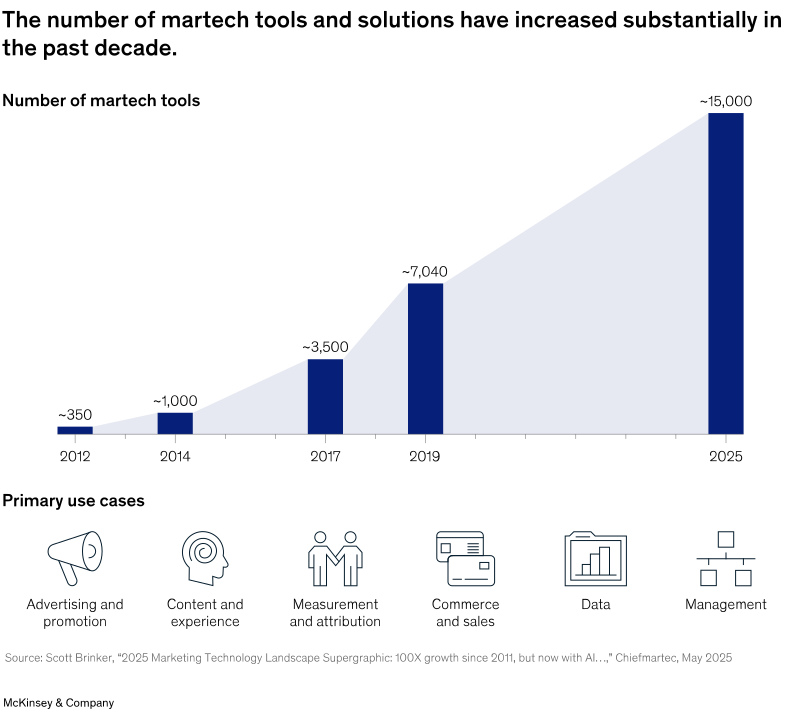
In October 2025, McKinsey published Rewiring martech: From cost center to growth engine, drawn from a survey of more than 200 senior marketing and technology leaders at Fortune 500 companies and in-depth interviews with over 50 CMOs. The headline finding, reported widely in Fortune and elsewhere, asked a question that should have been routine: what is the ROI of your marketing technology stack?
Zero of them could answer it.
Not “most struggled to answer it.” Not “the answers varied widely.” Zero. None. A clean shutout across fifty of the largest marketing organizations in the world. Companies collectively spending into the tens of billions of dollars on the platforms many of you sell, implement, and support.
The same study found that 65% of B2C organizations rate their MarTech maturity as basic or operational, meaning the stack is installed, but the advanced capabilities that justified the purchase are not in production use. The platforms are deployed. The outcomes aren’t.
For a vendor audience, this is the most important data point in the category, and it’s being underused.
What this finding means for your renewal book
The conventional read is that this is a customer problem. CMOs need to get better at measurement. Marketing organizations need to mature. Buyers need to do the work.
That read is wrong, or at least dangerously incomplete. Here is the version that matters for the people reading this:
If your customer’s CMO cannot quantify the ROI of your platform, your renewal is not safe. It is contingent on the absence of a forcing event.
The forcing event might be a CFO review, a CEO transition, a board-level cost rationalization, an activist investor, or simply a new CMO who wants to plant a flag. When the forcing event arrives (and in the current environment, it is arriving more often) the platform without quantified ROI is the platform that gets cut, consolidated, or replaced.
This is the mechanic behind the churn patterns showing up across the category right now. It is not that your platform stopped working. It is that nobody on your customer’s side can defend it in the room where the decision gets made.
The activation gap, measured
The McKinsey finding is the macro version of a pattern visible everywhere in the installed-base data:
A leading reverse-ETL platform has more than one hundred G2 reviews of its core syncing capability and twelve to fourteen reviews of its advanced AI Decisioning and Journey Orchestration features. Customers bought the advanced SKUs. They are not using the advanced SKUs.
A major pet retailer running a top-tier composable stack (CDP, reverse ETL, modern data warehouse, enterprise ESP, on-send personalization) operates at an Email Power Index of 0.73. A direct competitor running a substantially simpler stack operates at 69.62. A 95x gap between two companies in the same vertical, with the more sophisticated infrastructure on the losing side.
A national airline runs 1,582 campaigns in a single month against three billion sends. Triggered messages, the highest-performing program type by a wide margin, account for 2.4% of total volume. The promotional-to-triggered ratio is 35:1. The platform is capable of more. The program is not running it.
These are not edge cases. They are the shape of the category. Customers are buying capability they do not deploy, and the vendors who sold the capability are carrying the renewal risk.
What this means for the people reading this
Three implications worth sitting with.
First, customer health metrics built on usage of core features are misleading. A customer can be a heavy user of the core platform and still be at severe renewal risk because the advanced SKUs – the ones that justified the price increase, the multi-year, the expansion – are dark. The health score says green. The renewal conversation says otherwise.
Second, competitive displacement in this category is increasingly not about features. It is about the customer’s ability to point at outcomes. A competitor with a worse product and a customer who can defend the spend will beat a better product and a customer who cannot. The McKinsey finding is the leading indicator of the next wave of consolidation losses.
Third, the partners who can move customers from “deployed” to “activated” quickly, measurably, and without requiring a new platform purchase are the partners who protect the installed base. This is the structural reason activation-layer partnerships are becoming a CRO-level concern rather than a CS-level one.
The version of this you’ll read in vendor marketing
You will see versions of the McKinsey finding cited in vendor decks for the next eighteen months. They will mostly be cited as evidence that customers need to buy more. More platform, more modules, more services. McKinsey’s own data shows that 80% of CMOs plan to increase MarTech spend over the next five years. That framing is wrong, and it is the framing most likely to accelerate the churn it is trying to solve.
The customers in the McKinsey study are not under-invested. They are under-activated. The platforms are already paid for. The capability is already installed. The gap between what was bought and what is running is where the renewal risk lives, and it is also where the expansion revenue lives for the vendor or partner who closes it.
This is the problem Solvenna’s QuickLift program was built to solve > moving customers from deployed to activated quickly, without requiring a new platform purchase. If you’re a vendor carrying renewal risk in your installed base, it’s worth a conversation.
Burn Rate will spend a lot of time on this gap. It is the most important dynamic in the category, and it is the one with the least honest reporting around it.